Court Ruling Leaves Maryland Communities Without Stronger Industrial Stormwater Protections
A recent court decision has upheld Maryland’s statewide industrial stormwater permit—a permit that Blue Water Baltimore and our environmental partners have argued does not do enough to protect communities and waterways from toxic pollution.
Earlier this month, the Circuit Court for Baltimore County upheld the Maryland Department of the Environment’s 20-SW General Permit for Stormwater Associated with Industrial Activity. The permit governs pollution controls at more than 1,000 industrial facilities across Maryland, including scrapyards, manufacturing plants, auto yards, landfills, and coal-handling facilities.
Blue Water Baltimore joined Gunpowder Riverkeeper, Potomac Riverkeeper Network, the Chesapeake Bay Foundation, the Environmental Integrity Project, and Chesapeake Legal Alliance in challenging the permit.
Although we are disappointed by the ruling, the need for stronger protections has not changed.
What is industrial stormwater pollution?
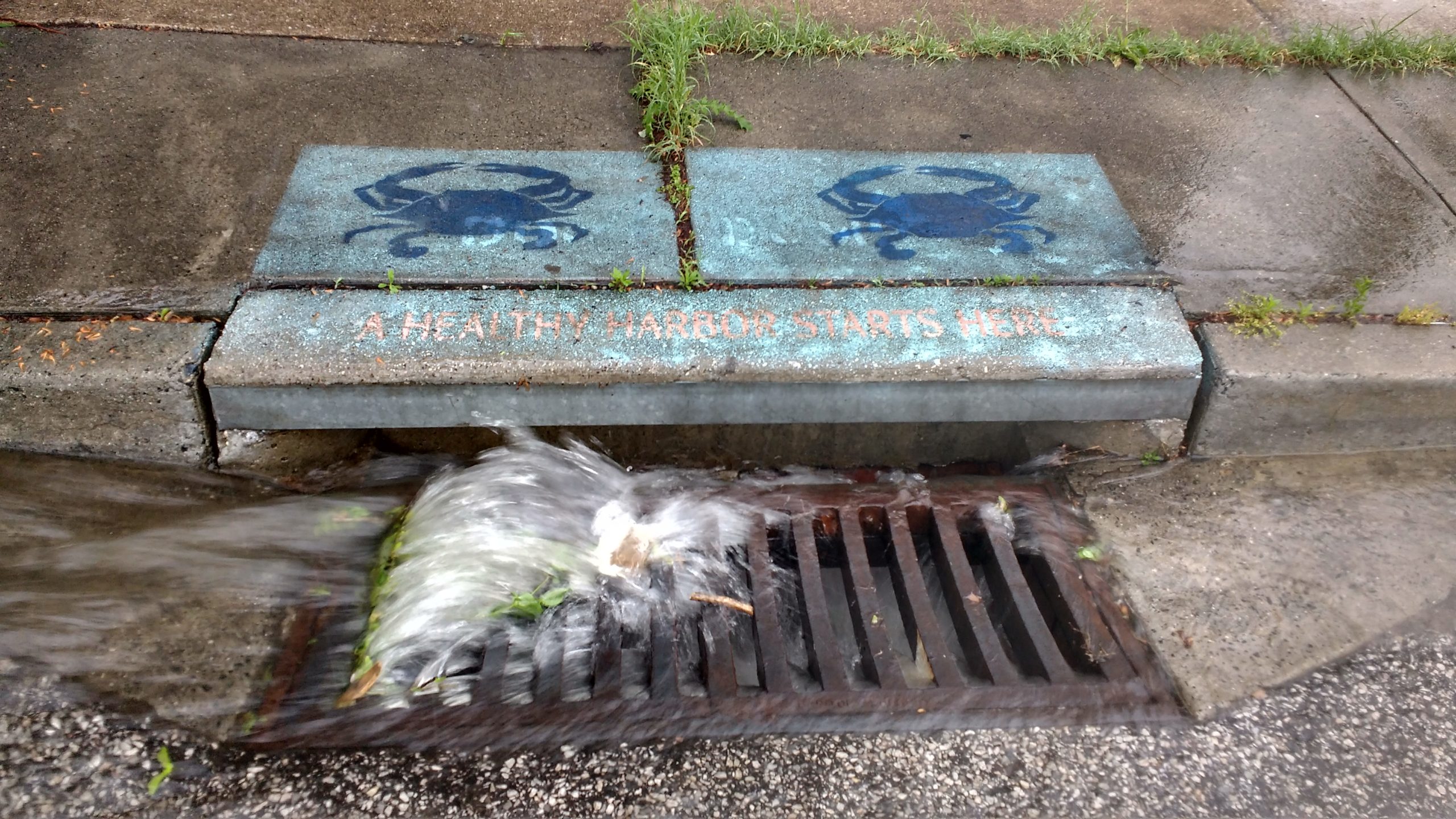
When rain falls on industrial properties, it can carry oil, grease, heavy metals, chemicals, sediment, and other contaminants into nearby storm drains, streams, rivers, and the Chesapeake Bay.
Unlike pollution that comes from a specific source, stormwater runoff can be difficult to see and track. But its effects are serious. Poorly managed runoff can contaminate waterways, cause flooding that damages homes and businesses, and create health and safety risks for nearby communities.
Climate change is making the problem more urgent. Maryland is experiencing heavier and more intense rainfall, which means more polluted runoff can reach waterways unless industrial sites have effective pollution-control practices in place.
Stormwater is now Maryland’s fastest-growing source of water pollution. Between 2009 and 2023, the state made no progress in reducing stormwater pollution.
Why environmental groups challenged the permit
The 20-SW permit is intended to carry out the protections of the federal Clean Water Act at industrial facilities throughout Maryland.
Environmental advocates argued that the current permit:
- Does not adequately account for increasingly intense storms caused by climate change
- Allows toxic pollutants to enter rivers and streams
- Includes insufficient monitoring, inspection, and enforcement requirements
- Places communities located near industrial facilities at continued risk
- Fails to provide the accountability needed to reduce pollution over time
The Maryland Department of the Environment issued the original permit in November 2022. After environmental groups raised extensive concerns and filed a legal challenge, the agency released an updated permit in February 2025. However, advocates found that the revised version included few meaningful improvements.
The groups presented oral arguments in April 2026 but in July, the court ruled that the permit complies with state and federal law.
Baltimore’s waterways still deserve stronger protections
The ruling does not change what we see throughout the Baltimore region: industrial pollution continues to threaten the Patapsco River, Back River, Baltimore Harbor, and the streams that flow through our neighborhoods.
“Industrial pollution is choking the Patapsco and Back Rivers, and slowly killing the Chesapeake Bay,” said Alice Volpitta, Baltimore Harbor Waterkeeper with Blue Water Baltimore. “We are disappointed by the court’s decision, but this ruling doesn’t change the fact that Baltimore’s streams, rivers, and Harbor deserve stronger protections. That’s exactly what we’ll keep fighting for.”
Industrial pollution is also an environmental justice issue. Many industrial facilities are located near homes, schools, parks, and public spaces. Communities living closest to these sites are often the first to experience contaminated water, flooding, odors, property damage, and other consequences of inadequate oversight.
Marylanders deserve permits that prevent pollution, not permits that allow problems to remain undetected.
What happens next?
Blue Water Baltimore and our partners are considering potential next steps in the legal case. At the same time, we are calling on the Maryland Department of the Environment and the Maryland General Assembly to strengthen the state’s stormwater policies and permitting systems.
Over the next year, Maryland residents will have opportunities to speak up as the state updates major Municipal Separate Storm Sewer System permits, commonly called MS4 permits. New stormwater legislation is also expected during the 2027 Maryland General Assembly session.
The Maryland Department of the Environment is beginning the process of developing the next version of the industrial stormwater permit. That process must meaningfully include residents, environmental advocates, and communities living near industrial facilities.
Blue Water Baltimore will continue working with our partners to advocate for stronger pollution limits, meaningful monitoring, better enforcement, and greater accountability.
Baltimore’s waterways, and the people who live alongside them, deserve nothing less.
For more information about industrial stormwater pollution, Blue Water Baltimore’s legal advocacy, and ways to speak up for stronger protections, visit our Advocacy page and sign up for BWB updates to stay informed about upcoming opportunities to take action.